



To our members and to society at large,
Free Speech Union Brasil (FSU-BR) has completed its first month of activity, with achievements that would make an organisation proud if it had been active for years. In so little time, we have already secured tangible victories, achieving national visibility in defence of the cause.
The Free Speech Union model (an international alliance of organisations defending freedom of expression), already present in five countries, has arrived in Brazil, and its instant success in the country leaves no doubt: the Brazilian people were crying out for this.
This report presents the highlights of FSU Brazil’s work in just one month of activity.
We hope these results convey our enthusiasm for the cause.
The Board
April 12, 2026
Reversal in the Monark case
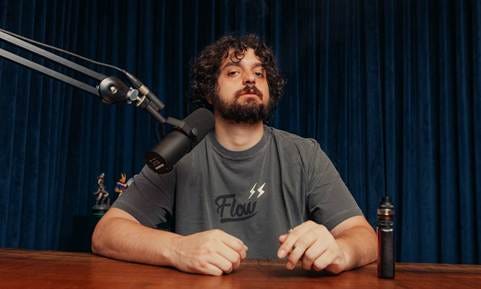
FSU Brazil achieved what seemed impossible: reversing fortune in favour of our member Bruno Aiub, who goes by the name Monark (a famous podcast host often referred to as “the Brazilian Joe Rogan”). Thanks to FSU Brazil’s decisive action, Monark was able to be defended in court by highly qualified lawyers with academic work in the field of freedom of expression, and they achieved something of even greater symbolic value than a favourable court ruling: persuading the Public Prosecutor’s Office itself to withdraw the accusation it had brought against Monark, on 31 March, days after the defence was submitted. (For now, the presenter has won the battle but not yet the war: the case still awaits a court decision.)
The prosecuting authority belatedly acknowledged (four years after the facts) what sensible voices had pointed out from the start: Monark never defended Nazism or antisemitism on his programme, but merely expressed his anarchist ideology, defending absolute freedom of expression and association in what concerns the state’s intervention. These absolute freedoms in Monark’s political creed would, by definition, include even Nazis and antisemites within their scope of protection, although the presenter strongly condemned those groups on the programme and argued that they should be fought by society in other ways.
A pioneering podcast host in the country, Monark had been unjustly cancelled and subjected to a media lynching through sheer misunderstanding of his remarks, leading to loss of sponsors and, in the end, the loss of the very podcast he had helped to found. The misunderstanding of his remarks also led to that lawsuit from the Public Prosecutor’s Office, demanding the payment of R$ 4 million (roughly 800,000 USD) in “collective moral damages”.
In 2023, Monark was offered a settlement under which the Public Prosecutor’s Office would refrain from bringing the action. One of the conditions demanded was that the podcast host make a public statement renouncing his anarchist ideas and defending that the state be granted powers to ban Nazi parties. In other words, the picture was one where the state was trying to coerce an individual into renouncing his anti-state ideas.
Faced with that prospect, Monark followed the example of the Greek philosopher Socrates, who, in 399 BC, chose to die at the hands of the state sooner than renounce his beliefs. Monark adopted the same stance and refused to renounce his ideas — but, fortunately, has had more luck than the Greek philosopher so far, inspiring all Brazilians to follow his example and not give up fighting for their freedom of expression.
Monark commented on his victory in court (albeit a temporary one): “I thank Free Speech Union Brasil for helping me in this fight. I am pleased that the Public Prosecutor’s Office has regained its sanity, because there was clearly no attack on any Jewish community, or anything of the sort. It is also a victory for Brazil — a victory for the possibility of discussing delicate and important issues.”
(Temporary) defeat of the Misogyny Bill
FSU Brazil helped to “bury” (in the words of one member of parliament) the Misogyny Criminalisation Bill (PL 896/2023). According to several sources, an agreement was made that the bill would not be put to vote in the Brazilian Chamber of Deputies before the elections.
The bill, which was one of the greatest threats to freedom of expression in the Brazilian legislature, sought to turn into a crime the extremely vague conduct of “practising prejudice on grounds of misogyny” (hatred of or aversion to women). In practice, the bill might grant almost limitless powers to police chiefs, prosecutors and judges to criminalise individuals for any speech whatsoever (including speech of social value, such as scientific debates or political criticism of women in positions of power) by a sort of mind-reading criterion, based on the allegation that the citizen had been internally motivated by prejudice against women.
The bill was “buried” (at least for now) in reaction to an unfavourable wave of public opinion, to which FSU Brazil contributed through an intense social media campaign launched on 16 March, in the organization’s very first days of activity.
Traces of the campaign (such as images and text drafted by FSU-BR) were found in far-flung places, such as Telegram groups, by supporters of the bill, who devoted themselves to investigating the “attacks on social media” the bill had been suffering.
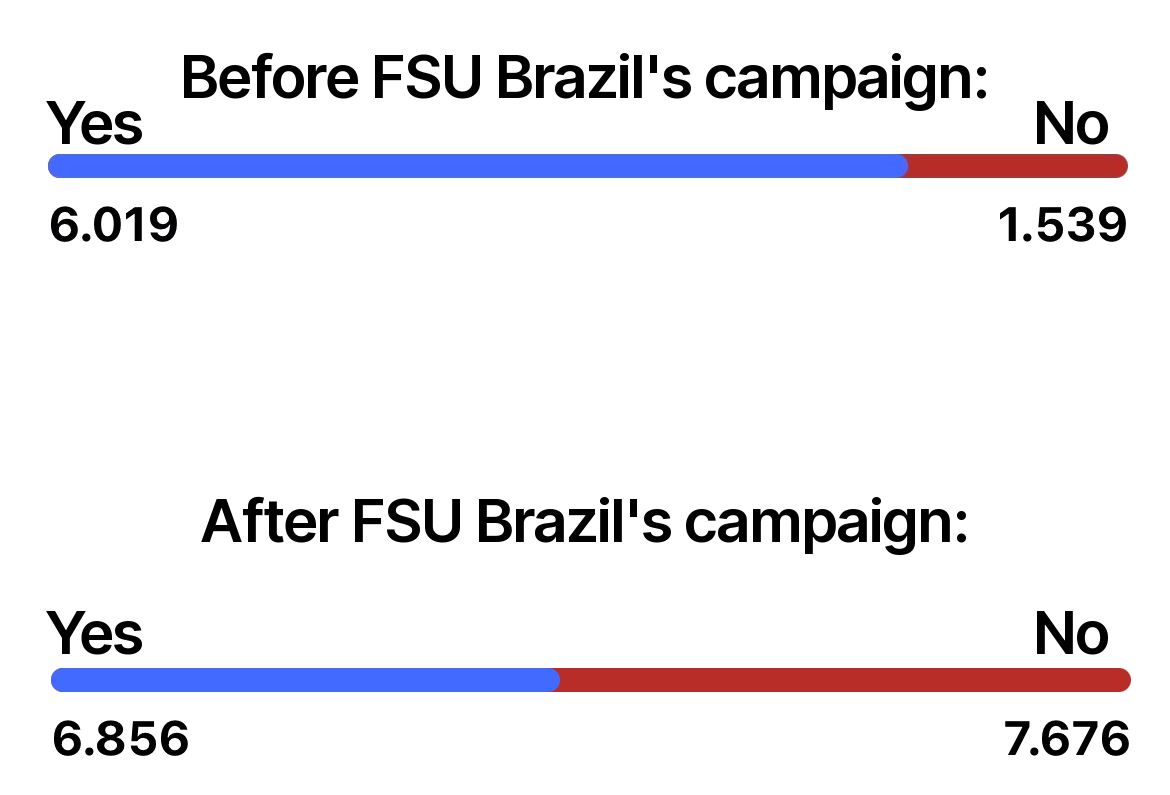
The impact of the campaign was also evidenced by the official poll on the Senate website. After a targeted week-long campaign, with calls to action, FSU Brazil managed to reverse the poll: what had begun as an overwhelming majority in favour of criminalising “misogyny” came to show a majority against:
FSU Brazil’s scoop: Flávio Bolsonaro’s explanation for his vote
Still in the context of the debates on the Misogyny Bill, FSU (represented by its Communications Director, journalist David Ágape) was responsible for a national scoop, being the first organisation to extract from Senator and presidential pre-candidate Flávio Bolsonaro (PL-RJ) an explanation for his vote in favour of the censorial bill.
The senator told FSU Brazil he had voted in favour of the bill because circumstances had forced him to do so, to avoid falling into a “trap” (in his words) set up by his rivals in the main left-wing party, and that he hoped his allies in the Chamber would overturn the bill that had then been approved in the Senate.
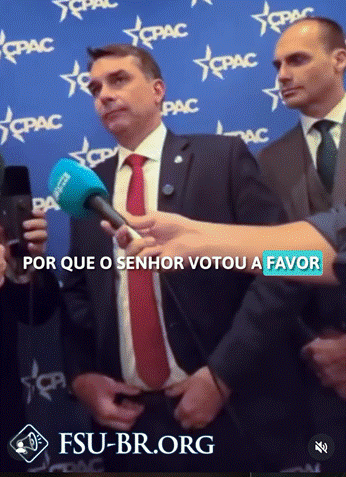
The senator’s explanation, obtained by FSU Brazil, had national repercussions and helped reinforce in the public debate, in an election year, the issue of censorship of so-called “misogynistic” speech.
The Censorship Traffic Light

In the wake of the campaign against the Misogyny Bill, FSU launched the “Censorship Traffic Light”, its permanent legislative monitoring project. FSU’s goal is to be Brazilian society’s chief sentinel against bills that threaten free speech.
The Censorship Traffic Light classifies bills into 🔴THREATS (bills that must be stopped), 🟡RISKS (bills that raise the alarm but may be modified to remove the risk of censorship), and 🟢PROTECTIONS (bills that provide greater guarantees) for freedom of expression in Brazil.
Likewise, the Traffic Light classifies provisions of laws already in force, to indicate which parts of Brazilian legislation should be reformed or repealed to guarantee freedom of expression. The aim is to guide FSU Brazil’s legislative front of action.
Anti-censorship legislative action
FSU does not confine itself to campaigning against extisting bills in Congress: it also has its own agenda, promoting draft legislation to defend freedom of expression, an activity it has already begun to carry out in its first month of existence.
Thus, at the same time as FSU fought for the Misogyny Bill to be wholly rejected, the organization has drafted amendment proposals (in dialogue with members of parliament) to reduce the bill’s harms or even turn it into something with a net positive effect for freedom of expression in Brazil, using the controversy raised by the bill as an opportunity to correct longstanding problems in the country’s pre-existing “Racism Act”, which the controversy helped make more visible.
Likewise, FSU Brazil has already begun discussions with members of parliament to reform the legal provisions that have been allowing million-dollar lawsuits to be filed demanding “collective moral damages” for speech (such as the lawsuit filed against FSU Brazil’s member, Monark). The goal is that this type of lawsuit should cease to exist as an instrument of intimidation against Brazilians who make use of their free expression.
“Not Messias”

FSU also gained prominence by promoting the petition “Messias, não” (“Not Messias”), intended to gather signatures demanding that the Brazilian Senate reject the nomination of the Attorney General of the Union, Jorge Messias, to the office of Justice of the Supreme Federal Court.
As of the present date, the petition has already gathered 12,000 signatures in one week.
As grounds for the petition, FSU cited Messias’s history of action against freedom of expression, especially while heading the National Prosecutor’s Office for the Defence of Democracy (PNDD) – a body dubbed the “Ministry of Truth” by critics, as it has been used by the federal government to intimidate opponents through threats of lawsuits for “disinformation” against the government.
Media appearances
FSU Brazil has enjoyed much exposure in the media in its first month of existence, an encouraging sign for the organisation’s future.
The organisation’s president, Eli Vieira, and vice-president, Hugo Freitas, appeared in the journalist Claudio Dantas’s programme to discuss Monark’s case. They took the opportunity to explain the purpose of the new anti-censorship organisation in Brazil, inspired by its British namesake.

Vice-president Hugo Freitas returned in another edition of the programme to explain a report by the US Congress denouncing censorship in Brazil.

The president and vice-president of FSU Brazil were also invited onto the podcast Tapa da Mão Invisível, hosted by Paulo Fuchs, to explain how the Misogyny and Antisemitism Bills in Congress threatened freedom of expression.

The partial judicial victory of FSU Brazil and its member Monark, upon the retreat of the Public Prosecutor’s Office, was reported by all the country’s main media groups, such as the newspaper Folha de São Paulo and the news site G1 (from the Globo group).
The newspaper Estado de São Paulo even devoted an editorial to the case, with the title “Freedom of expression, albeit belatedly” and the standfirst: “The shelving of the Monark case corrects a glaring error but exposes a persistent vice: the willingness of part of society and of the institutions to criminalise controversial opinions.”
Conclusions
Few civil society organisations achieve tangible victories so soon after being launched. Less than a month after beginning its efforts, Free Speech Union Brasil had already scored a victory in a nationally famous freedom of expression court case and helped stop a censorship bill in Congress, among other actions.
Moreover, FSU Brazil has enjoyed instant popular success, which clearly points to the existence, in Brazil, of pent-up demand for an organisation working for the cause of free expression along our lines.
FSU Brazil quickly gained more than 7,000 followers on social media in its first few weeks and its posts have had an engagement rate above 10%, an exceptionally high figure by market standards.
All these results point to a strongly positive prognosis for Free Speech Union Brasil.
Donate to FSU Brazil
The results obtained in FSU Brazil’s first month of activity depended on an intense concentration of effort. To maintain these results sustainably over time, FSU Brazil depends on you.
If you are not yet affiliated, it will be a pleasure to have your presence among our members, who are the chief people responsible for all these achievements. Join through the form at fsu.org.br/filie-se.
You may also help through donations of any amount, which may be sent by any of the means below:
Stripe donations :
Bank transfers:
Bank name: BS2 SA
SWIFT code: BBONKYKYXXX
Account holder: FSU BR UNIAO PELA LIBERDADE DE EXPRESSAO
Account number / IBAN: KY6531630600010511952300
Currency: USD
Intermediary bank (if required): The Bank of New York Mellon
Intermediary SWIFT: IRVTUS3N
ABA: 021000018
Is there any possibility of working with left-wing figures who themselves suffered censorship during the dictatorship in Brazil... thinking of Chico Buarque first of all, of course!